Copper peptides present a fascinating paradox: they appear deceptively simple on a product page yet introduce genuine complexity once inside your workflow. Not because the chemistry is incomprehensible, but because copper introduces variables that many laboratories overlook until something starts drifting. With GHK-Cu peptide, the difference between clean, reproducible research and frustrating inconsistency almost always comes down to verification fundamentals and intentional handling.
This guide delivers a practical research baseline: what GHK-Cu copper peptide represents scientifically, how quality is actually defined, and how to maintain stability through proper storage, preparation, and documentation. If you are sourcing this compound, begin by reviewing GHK-Cu peptide, then construct a routine your team executes consistently.
What Is GHK-Cu in Research?
GHK-Cu is a naturally occurring copper complex of the tripeptide glycyl-L-histidyl-L-lysine. In research environments, the “copper complex” aspect is not a minor footnote — it fundamentally influences how you handle the compound. Copper affects stability, oxidation behavior, and environmental interactions, meaning your workflow must be more deliberate than it would be for standard non-metallic peptides.
Research programs using GHK-Cu copper peptide typically seek controlled, repeatable conditions where the compound’s identity and integrity remain stable enough to support meaningful comparisons. The goal is not hype or vague promises. It is a clean, verifiable input you can trust across months of experiments.
To contextualize this product within a broader sourcing framework, explore the Peptides collection for format comparisons and procurement consistency.
Why Copper Changes Your Workflow
Standard peptide workflows assume that purity plus proper storage equals predictable behavior. Copper peptides can absolutely be predictable, but environmental factors matter disproportionately. Light exposure, container composition, and unintended contaminants can exert larger effects than teams anticipate.
Three practical considerations distinguish GHK-Cu copper peptide handling:
Oxidation sensitivity: Copper can catalyze oxidative reactions if conditions are not carefully controlled. Minimizing exposure to air and oxidizing agents becomes essential.
Surface interactions: Certain container materials interact unfavorably with copper complexes. Your SOP should specify appropriate vessel composition.
Solution dynamics: Concentration, pH, and exposure duration influence post-reconstitution stability. Document these parameters explicitly.
None of this implies fragility. It simply means GHK-Cu peptide rewards meticulous habits and penalizes careless ones.
Purity and Identity: More Than Numbers
With any peptide, purity matters. With copper peptides, purity and identity matter together inextricably. A clean purity percentage helps, but without method clarity and lot traceability, it is insufficient for serious research.
When your laboratory selects GHK-Cu copper peptide, you must document what was received, how it was verified, and how it was stored. Otherwise, when results shift weeks later, you cannot distinguish genuine biological findings from material variability.
Treat the compound as part of your experimental design from procurement forward. Your protocol begins when you place the order, not when you enter the lab.
Reading a GHK-Cu COA Properly
A Certificate of Analysis answers one fundamental question: does this lot match its claimed identity, and can you defend that claim in your records?
For GHK-Cu copper peptide, COA review determines whether you proceed with confidence or identify critical gaps before the vial touches your workflow.
Critical COA Components
Lot or batch number: Must match your vial label exactly. Lot traceability underpins reproducible science.
Stated analytical method: HPLC is standard for purity profiling. The method must be explicitly stated with the resulting value.
Lot-specific documentation: The COA should feel tailored to your specific vial, not like a reusable template that could attach to any product.
Identity confirmation: Beyond purity percentages, consider whether identity verification (mass spectrometry, for example) meets your internal standards for sensitive work.
The objective is defensible inputs, not paperwork accumulation.
HPLC Testing: Useful Baseline, Not Complete Protection
HPLC provides a chemical profile showing whether your sample is dominated by one component or contaminated with impurities and degradation products. This profile matters because impurities generate noise that masquerades as biological effects in sensitive assays.
However, HPLC is not comprehensive. A pristine COA does not protect against post-arrival mishandling. With GHK-Cu peptide, verification provides your baseline; your SOP preserves that baseline over time.
Remember: HPLC validates your starting point. Your handling discipline determines where you finish.
Storage Practices That Protect Stability
For most laboratories, peptide drift originates from mundane sources: temperature cycling, moisture exposure, and inconsistent access habits. Copper peptides are particularly vulnerable to sloppy routines, making process discipline especially valuable.
Maintain Consistent Storage
Whatever your SOP specifies, consistency reigns supreme. Avoid locations subject to temperature fluctuations. Minimize bench time. Transfer to controlled storage immediately and keep it there.
Minimize Vial Access Exposure
Repeated opening increases contamination and moisture exposure risks. If your workflow requires multiple accesses, prepare aliquots after reconstitution rather than cycling the original container repeatedly.
Control Light Exposure
Copper compounds can exhibit heightened photosensitivity. Minimizing light exposure during preparation and handling represents simple, effective protection against avoidable degradation.
The goal is not complexity. The goal is eliminating preventable variables.
Reconstitution Math: Keep It Repeatable
The finest peptide math is math nobody debates because everyone uses the identical standard. With GHK-Cu copper peptide, the primary risk is not mathematical complexity — it is inconsistency. One researcher uses 2 mL, another assumes 1 mL, and suddenly the same “dose” differs by a factor of two.
Select a reconstitution volume fitting your workflow requirements.
Use that exact volume every time for this product.
Record results in an identical format in your lab log.
For standardized conversions and dilution calculations, the Peptide Calculator eliminates team-member variability and prevents silent concentration errors.
A Lab Workflow for Consistent GHK-Cu Research
Clean outcomes require repeatable routines. Here is a practical model proven across research environments.
Step 1: Receive and Log
Upon arrival, log the date, storage condition, product name, and lot number. Save the COA where your team can access it. Link it digitally to your lot record if using inventory software. This step makes future troubleshooting possible.
Step 2: Verify Documentation
Match the COA to your vial lot. Confirm the stated test method. Ensure documentation completeness meets your laboratory standards. With GHK-Cu copper peptide, this verification prevents building workflows on assumptions.
Step 3: Disciplined Storage and Access
Store immediately per SOP. If repeated access is necessary, minimize warm-cold cycling and environmental exposure. Aliquot after preparation when feasible.
Step 4: Standardized Preparation
Consistent tools, timing, and technique produce comparable results. Record concentration, preparation date, and any deviations. Standardization across multiple team members is essential.
Step 5: Track Usage Across Experiments
Document which lot and preparation batch were used in each run. If results drift, you can correlate changes with specific lots, preparation methods, or storage windows.
Diagnosing Common Problems
When GHK-Cu peptide work produces inconsistent outcomes, laboratories often rush to modify protocols. Frequently, the issue is handling history rather than assay design.
Inconsistent reconstitution volumes: Different team members creating different concentrations that mimic biological effects.
Repeated temperature cycling: Progressive degradation from inconsistent cold storage practices.
Weak recordkeeping: Without lot and prep date tracking, drift becomes impossible to diagnose.
Overexposure during access: Extended bench time and repeated opening gradually compromise stability.
None of these require novel science. They require cleaner routines.
Integrating GHK-Cu Into Multi-Peptide Programs
Few labs work exclusively with one compound. Maintaining multiple peptides for different study designs demands standardized procurement and documentation across your entire inventory.
If your program includes adjacent peptides like BPC-157 and TB-500, apply identical documentation habits despite differing chemistries. Lot tracking, COA review, stable storage, and standardized preparation — the reliability rules remain constant.
Streamline your sourcing through the Peptides catalog with consistent verification standards across all products.
Frequently Asked Questions
Is purity percentage sufficient for copper peptides?
Purity is necessary but not sufficient. It must be tied to a stated analytical method and a lot-specific COA. For GHK-Cu copper peptide, verification establishes your baseline, but disciplined handling protects stability after the vial arrives.
What documentation does my lab need at minimum?
Lot number, COA, arrival date, storage condition on receipt, reconstitution volume, resulting concentration, preparation date, and storage location. These fundamentals make results comparable and troubleshooting feasible.
How do we prevent concentration errors with GHK-Cu?
Choose one standard reconstitution volume and apply it universally. Using the Peptide Calculator as a shared reference prevents inconsistent mg-to-mcg conversions across your team.
Stable Inputs, Clean Research
Copper peptides become exceptionally manageable when treated as what they are: inputs requiring verification, traceability, and consistent handling. If you desire repeatable outcomes, focus on controllable steps: rigorous COA review, meticulous lot tracking, stable storage, standardized preparation, and thorough recordkeeping.
Begin with GHK-Cu peptide, log your lot, verify your documentation, and execute the same preparation routine every time. Once this foundation is established, your results become interpretable, reproducible, and free from material-induced ambiguity.
All products are intended solely for laboratory research and are not for human consumption, diagnostic, or therapeutic applications.
Frequently Asked Questions
Is purity percentage sufficient for copper peptides?
Purity is necessary but not sufficient. It must be tied to a stated analytical method and a lot-specific COA. For GHK-Cu copper peptide, verification establishes your baseline, but disciplined handling protects stability after the vial arrives.
What documentation does my lab need at minimum?
Lot number, COA, arrival date, storage condition on receipt, reconstitution volume, resulting concentration, preparation date, and storage location. These fundamentals make results comparable and troubleshooting feasible.
How do we prevent concentration errors with GHK-Cu?
Choose one standard reconstitution volume and apply it universally. Using the Peptide Calculator as a shared reference prevents inconsistent mg-to-mcg conversions across your team.
If you’re new: this is the “why it matters” section. GLOW is designed to explore how multiple repair-related pathways can overlap in a coordinated way.
What is the GLOW peptide protocol? GLOW is a research-oriented multi-peptide framework combining
GHK-Cu (a copper-binding peptide studied for tissue remodeling signals),
BPC-157 (studied for cytoprotective and repair signaling in preclinical models),
and TB-500 (a thymosin beta-4 fragment studied for cell migration and tissue repair coordination).
It’s popular because it reflects a “systems” approach instead of betting everything on one signal.
What GLOW Is (and What It Isn’t)
Let’s keep this clean. Online you’ll see two extremes: hype like it’s magic, or people calling everything fake.
Reality sits in the middle: peptides can be useful research tools, but you have to talk about them with strict boundaries.
CoreVionRX stance: This article is education and research discussion only. Not medical advice, not a treatment plan, not a promise. These compounds are not FDA-approved therapies for human use.
The GLOW protocol is best understood as a framework:
a structured way to think about how separate signaling domains may overlap:
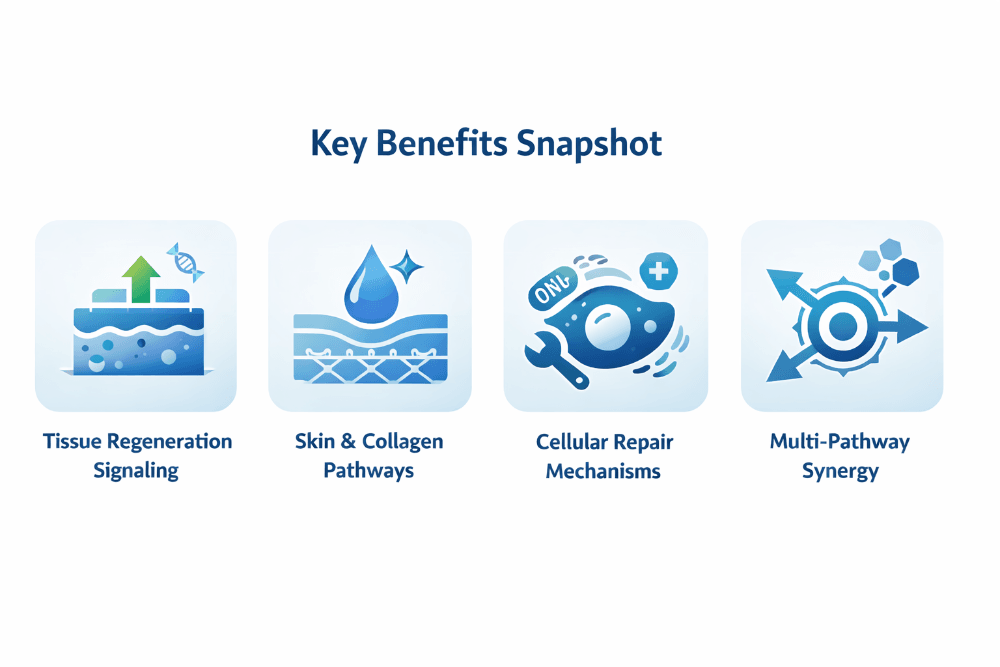
(1) tissue remodeling signals, (2) inflammatory signaling, (3) cellular migration/repair coordination, and
(4) collagen-related pathways and extracellular matrix organization.
Quick definitions (beginner friendly)
GHK-Cu: a copper-binding tripeptide studied for gene expression modulation and tissue remodeling signaling.
BPC-157: a synthetic peptide studied in preclinical models for cytoprotective and repair signaling (tissue integrity contexts).
TB-500: a thymosin beta-4 fragment studied for cellular migration, actin regulation, and repair coordination pathways.
Why Multi-Peptide Systems Became the Default (Biohacker Logic)
Here’s the honest explanation: stacking is an attempt to reduce bottlenecks.
If one signal relates to cellular migration and another relates to remodeling organization, the “systems” idea is:
overlapping signals might create a more complete environment than a single signal alone.
The “single-signal” problem
Even if a single compound triggers a repair-related signal, the system can still be limited by inflammation, ECM structure, mobility, or recovery constraints.
That’s why results can be inconsistent when people chase one magic ingredient.
The “systems” hypothesis
A coordinated set of signals can theoretically create a better overall environment for repair processes.
Not a guarantee — just a more interesting research question: “What changes when multiple signals overlap?”
Mechanisms & Synergy Logic (Clean Version)
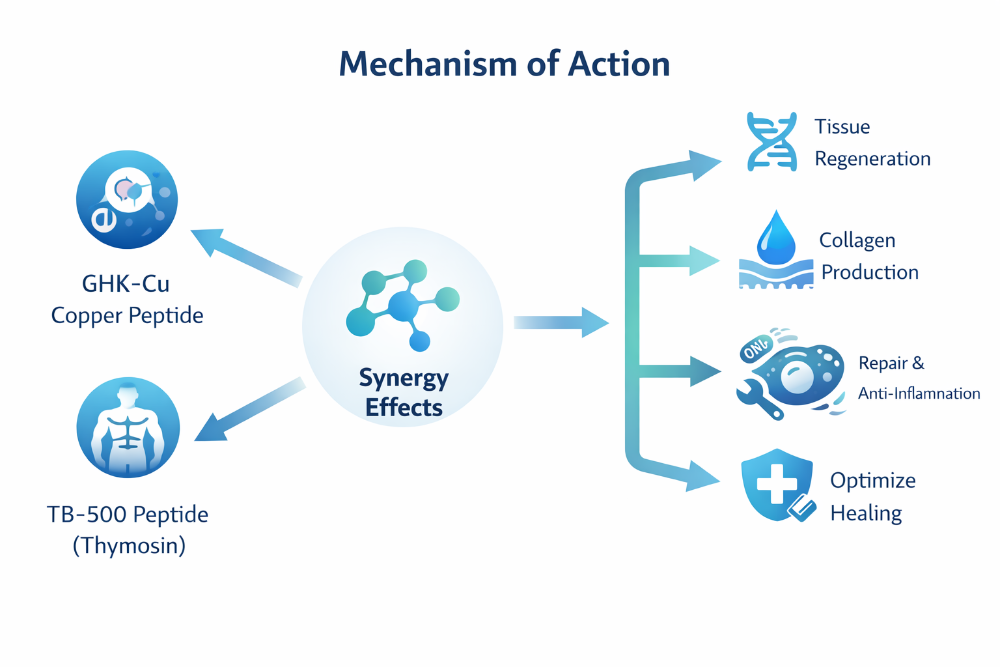
Simplified pathway role model. Educational diagram, not a clinical claim.
1) GHK-Cu: remodeling signals + copper context
GHK-Cu gets labeled “skin peptide” online, but that’s a lazy shortcut. The research interest comes from how copper-binding peptides may influence
remodeling-related signaling and how copper context intersects with collagen pathways and gene expression signals in cell models.
BPC-157 is widely discussed because preclinical research explores it in models where tissue integrity and repair signaling are being investigated.
The clean framing: it’s studied in scenarios tied to protective/cytoprotective signaling and tissue stress contexts.
3) TB-500: migration + coordination logic
TB-500 is commonly discussed around cell migration, actin-related dynamics, and repair coordination (thymosin beta-4 fragment research).
The reason it’s popular in stacks is simple: repair requires organization and movement, not just “growth.”
Direct Answer (AEO): GLOW’s synergy concept is that each peptide maps to a different “layer” of the repair conversation:
GHK-Cu (remodeling/collagen signaling context), BPC-157 (tissue integrity & protective signaling in models), TB-500 (migration/coordination logic).
Overlap can be more complete than a single-signal approach.
Peer-reviewed starting points people cite in these discussions:
Quality, Sourcing & How to Read a COA (Without Getting Played)
Real talk: most problems come from contamination, mislabeling, bad handling, or fake COAs.
If you care about results, you should care about proof.
What a real COA typically includes
Identity confirmation
Look for mass spectrometry (MS) or equivalent. Purity without identity can still be the wrong compound.
Purity testing
HPLC purity is common. Real reports show method details + sample ID + chromatogram—not just a number.
Batch specificity
COA should be batch-specific. If the vendor reuses the same COA, treat it as marketing.
Red flags
No lab name, no method, no sample ID, no date.
“99.9%” for every peptide, every time.
No handling or storage guidance.
Dodging questions about test methodology.
Reality: The best marketing is a clean COA from a credible third-party lab with real metadata. Everything else is noise.
Risk Framing & Logic (Research-First, Not Hype)
The internet loves “side effects lists,” but most lists are trash because they mix animal data, anecdotes, and guesses.
Correct way to think about this: uncertainty management. Unknown isn’t automatically “safe” or “danger.”
These compounds appear in research communities and preclinical literature.
Human-quality clinical outcome data is limited for many online use-cases.
Risk is dominated by sourcing + handling quality, not just the molecule.
Online content is not a substitute for a qualified clinician.
Compliance: CoreVionRX products are intended for research and educational purposes only. Not for human consumption.
How Researchers Design a Protocol (Without Turning It Into Bro-Science)
People always ask “what’s the dose?” — but that’s where online content turns messy fast.
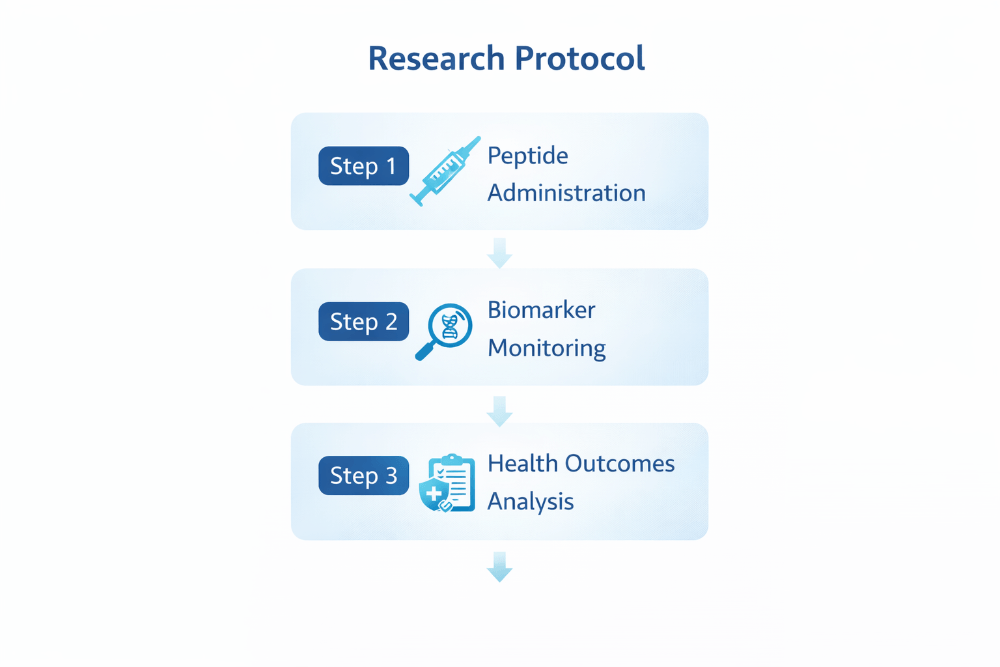
Better question: what variables are controlled, and what outcomes are measured?
Beginner model: Learn the basics first: COA, batch, stability, storage, and what “research-only” actually means.
Start with one clear research goal (skin remodeling signals vs recovery observation, etc.).
Track 2–3 consistent markers instead of 20.
Don’t change five variables at once — you learn nothing.
Pro move: use this same product card component across all peptide articles so the UX stays uniform.
Note: This article is educational. Product availability/pricing can change. Always refer to the product page for canonical details.
FAQ (Clear, Snippet-Ready)
GLOW is a research-oriented multi-peptide framework that combines GHK-Cu, BPC-157, and TB-500 to explore
overlapping signaling roles as a systems approach rather than a single-signal approach.
The combination reflects a synergy hypothesis: each peptide maps to a different layer of the “repair conversation”
(remodeling/collagen context, tissue integrity signaling in models, and cellular migration/coordination logic).
No. This is research-only education. These compounds are not FDA-approved therapies for treating disease.
This article is not medical advice.
Batch-specific COAs with method details, identity confirmation (often MS), credible HPLC reporting,
and documentation of handling/storage. Most bad outcomes come from contamination, mislabeling, or fake testing.
Define one goal, track a small number of consistent markers, avoid changing multiple variables at once,
and prioritize quality/documentation over hype.